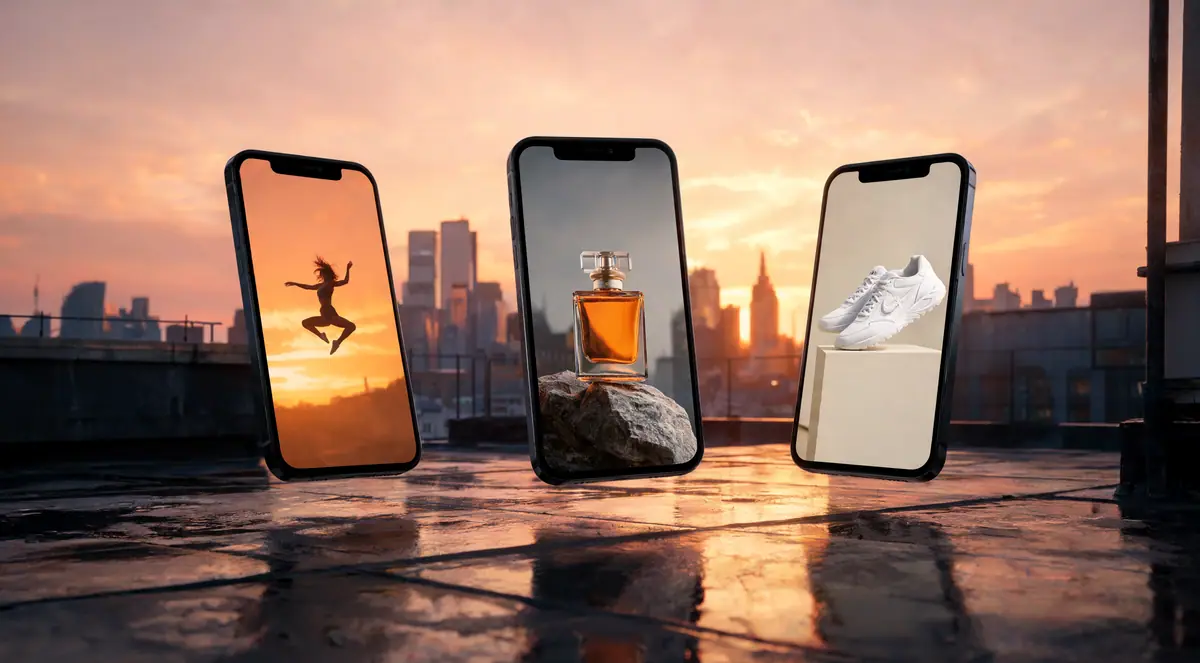
Most ad campaigns don’t fail on the idea. They fail on the edit. A strong concept gets shot once, then squeezed into every placement: a landscape film cropped into a vertical story, a feed post with the headline cut off by the interface, a square ad where the product sits in a corner. The result looks like what it is, a copy of something made for somewhere else.
AI ad creative tools change the economics here. When producing a new composition takes minutes instead of a reshoot, there’s no reason to ship a stretched version. This guide walks through how to plan one concept for every format, how to test it, and how to keep it on brand.
Start with one approved concept
Before generating anything, agree on the brief. A good ad brief fits on a card:
- Product: what you’re selling, with a clean reference image.
- Audience: who it’s for, in one sentence.
- Message: the single idea the ad should leave behind.
- Line: the headline or hook, written once.
- Look: two or three words for light, setting and mood.
Everything that follows is a variation of this card. If a version drifts from it, it’s off brief, however good it looks.
Compose for each format, don’t crop
Each placement has its own frame, its own interface on top, and its own way of being watched. Compose for each one.
| Format | Where it runs | Composition tip |
|---|---|---|
| 9:16 | Reels, Stories, TikTok, YouTube Shorts | Keep the subject and text in the middle band. The top and bottom carry the app’s own buttons and captions. |
| 4:5 | Instagram and Facebook feed | The tallest feed format. Put the hook in the top third so it reads before the thumb moves. |
| 1:1 | Feeds, carousels, marketplace and product listings | Square crops punish wide scenes. Bring the product closer and simplify the background. |
| 16:9 | YouTube, websites, connected TV | Room for a story. Leave a clean third of the frame for the headline. |
With an AI image or video model, you can generate the master scene once and then reframe or extend it for each ratio, keeping the product, light and color grade identical. That consistency is what makes four placements feel like one campaign.
Make variations that test one thing
AI makes it easy to produce dozens of versions. The temptation is to change everything at once, which makes results impossible to read. Change one variable per variation:
- Hook: the first second of a video, or the headline on a still.
- Visual: product close-up versus lifestyle scene.
- Line: benefit-led versus curiosity-led copy.
- Offer: with and without a price or promotion.
Run the variations against the same audience and budget, then keep what wins and replace what doesn’t.
Keep every version on brand
Volume is only useful if every version looks like you. Write down the rules once, in a brand kit, and generate against them every time:
- Colors and a short list of approved backgrounds.
- Typefaces and where the logo sits in each format.
- Voice: three words for how you sound, and a few lines you’d never write.
- Product rules: which angles, which packaging, what must never change.
Generate the scene with AI. Add text and logos in post. Models are good at light and composition, and unreliable at exact lettering.
Measure, then refresh
Watch click-through rate and cost per lead per variation, not just per campaign. When a winning ad starts to fatigue and costs climb, you already have the brief and the brand kit, so the next round of creative is a prompt away rather than a production.
How Auroscale does it
The Auroscale AI marketing agent takes a product or URL, drafts concepts, generates on-brand creative for every placement and launches it across Meta and Google. The paid ads agent then tracks performance and shifts budget to what works. For hero campaigns that need a director, Auroscale AI Studio produces the master film and stills.